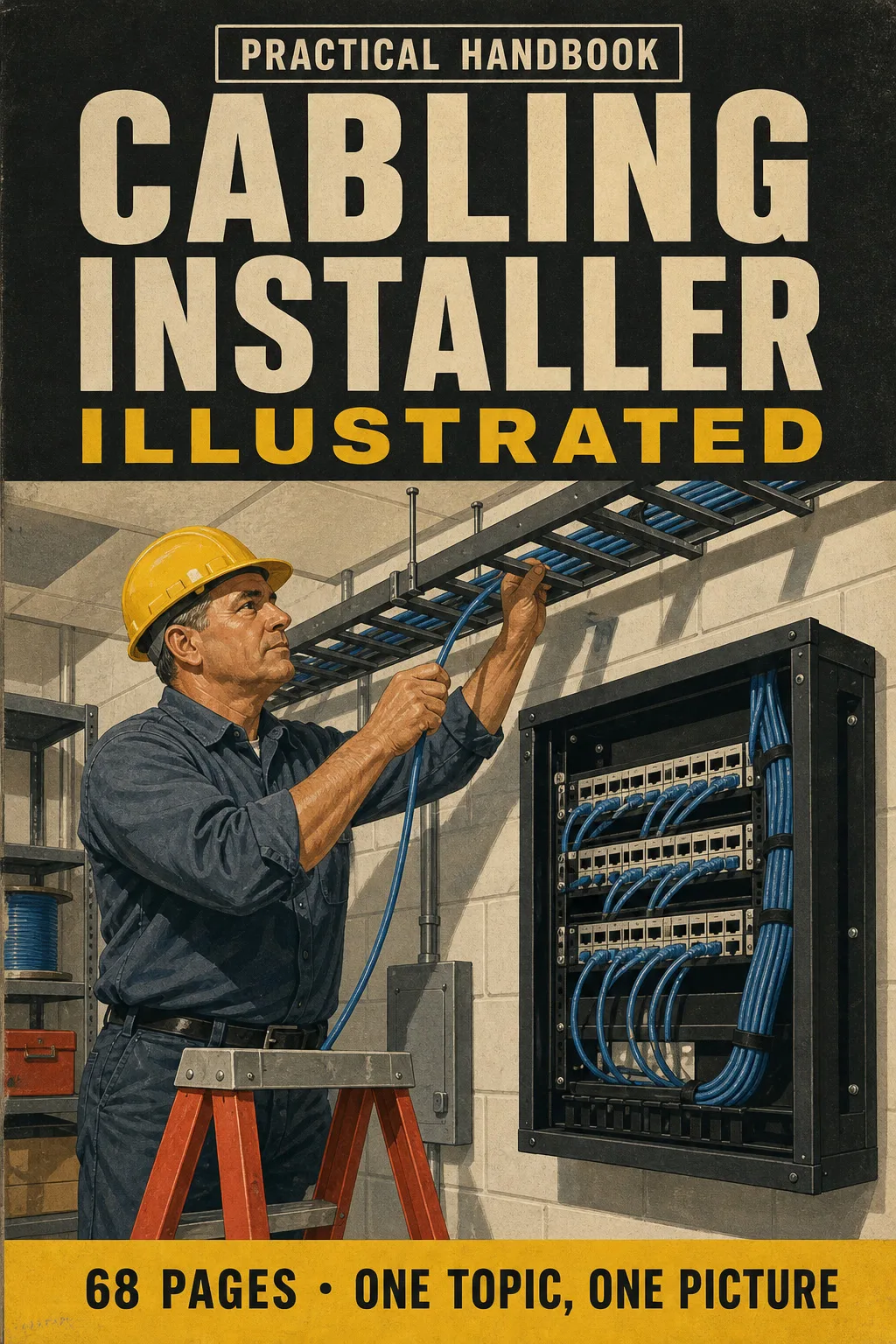
📄 Digital book in PDF · read it on your phone or print it
From the entrance facility to the wall jack, one topic per page: pinouts, conduit fill, bonding, fiber and the tester report. You see the drawing, read the numbers next to it and know what goes where. 68 illustrated pages.
🔒 Secure checkout · PDF by email · 30-day guarantee
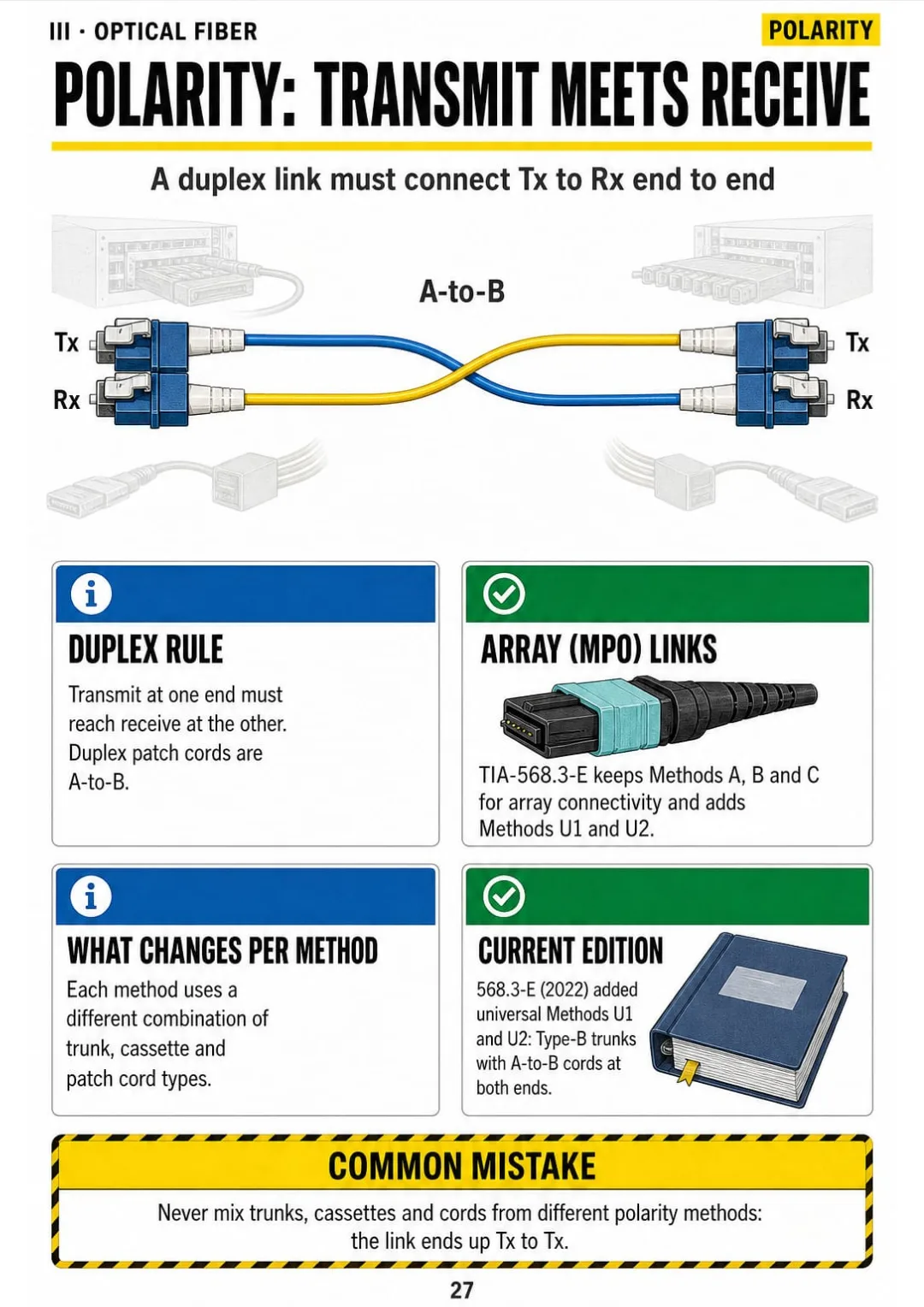
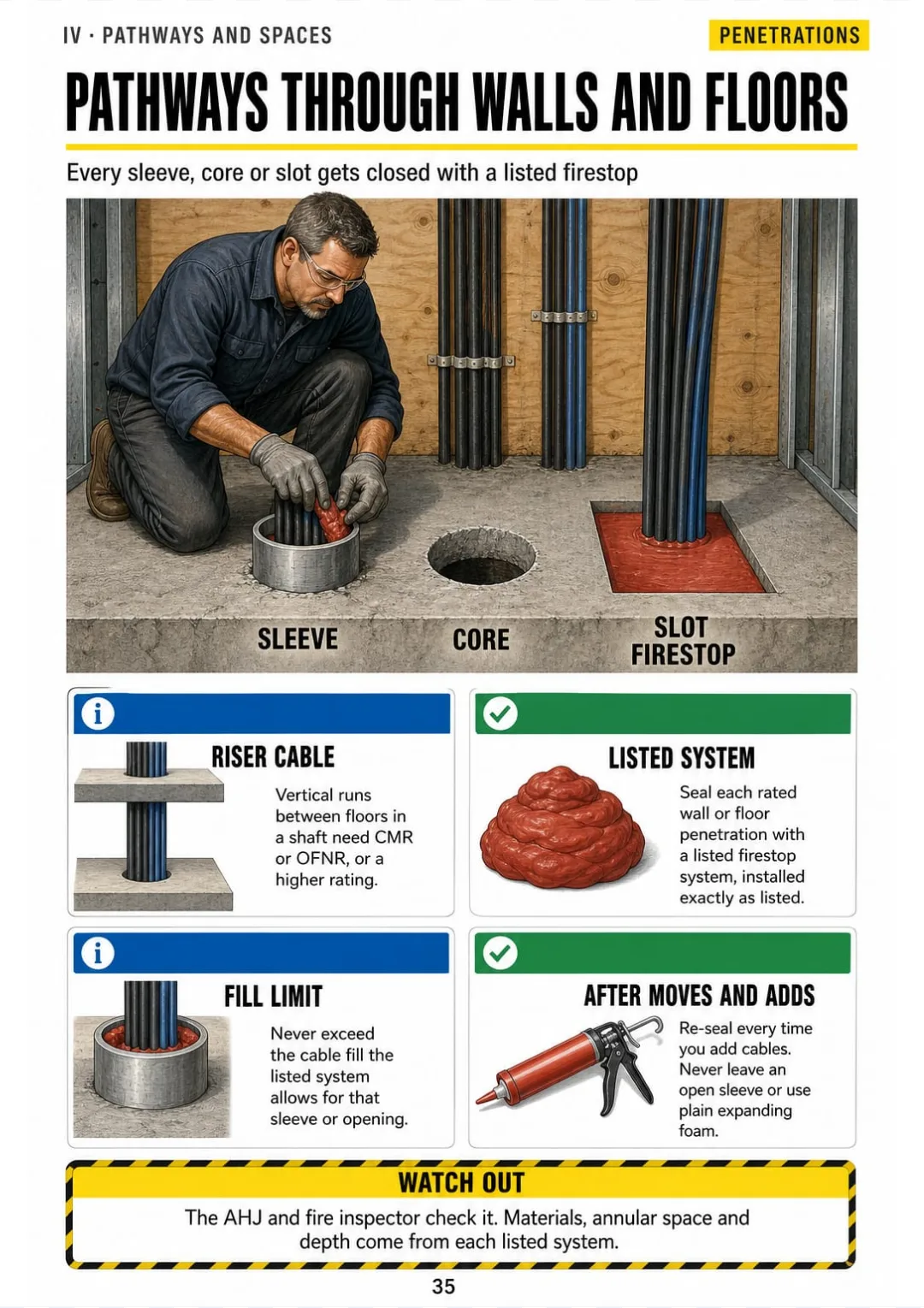
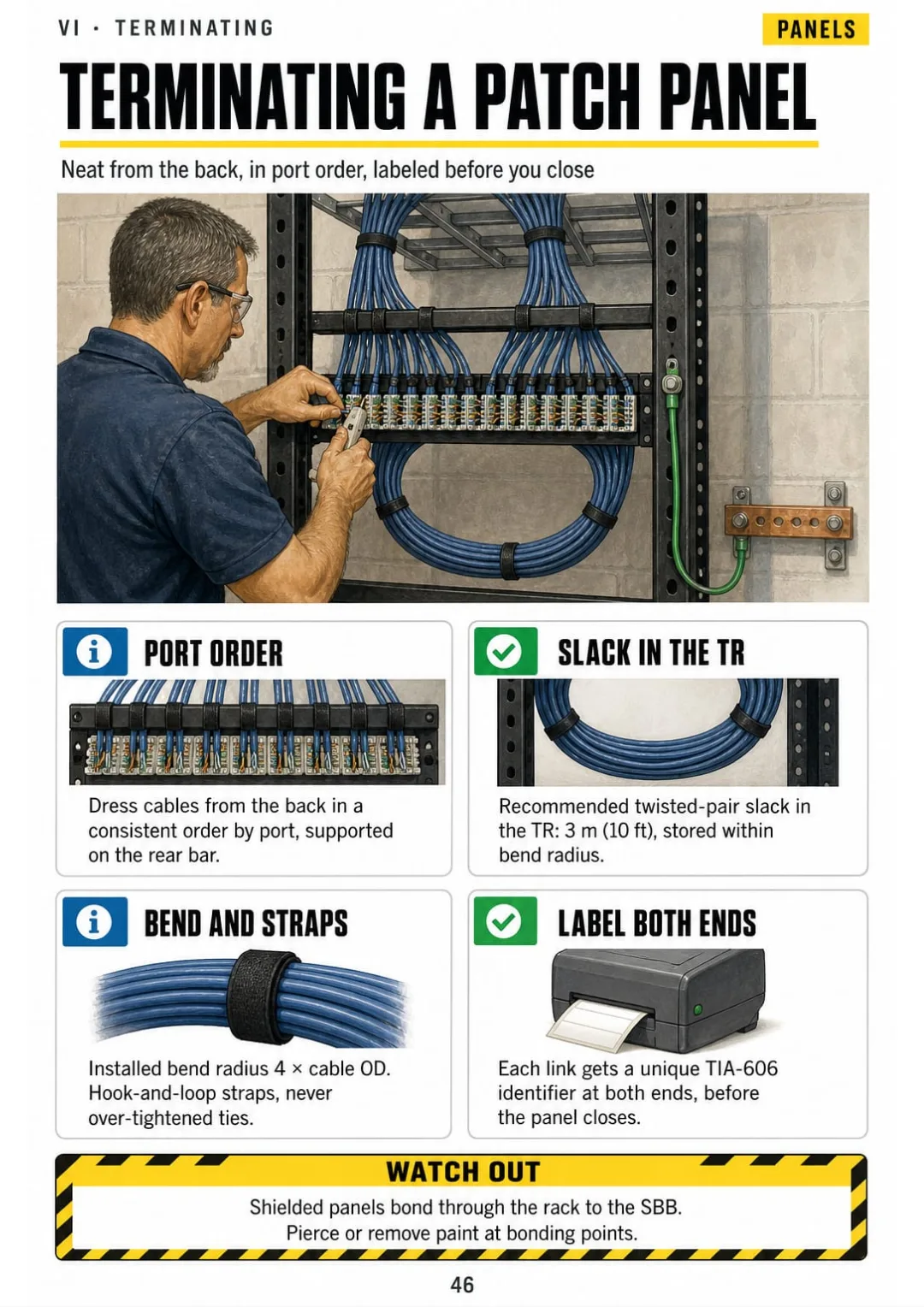
Every page has one big drawing and a box with the numbers and steps you need to know:


Swipe to see more →
These are real pages from the book. The table of contents is the full one: 9 parts and 64 topics.
You're at the bench for the hands-on test, eight conductors fanned out, the proctor watching. And for a second you can't remember if white-orange or white-green goes on pin 1.
The manual gives you T568A and T568B as two tables of pins and colors, plus a paragraph each. Two lists of eight that look almost the same don't hold up under pressure.

In the book, T568A and T568B sit side by side, pin by pin, in color. Pins 4-5 and 7-8 never change: only green and orange swap. One look and you know which pairs move.
The other topics work the same way: channel vs permanent link, CMP vs CMR, the 110 block, the 5 wire map faults, conduit fill. Each one gets its own page.
You look at the jack, you know the order, and you terminate it without going back to the manual.

From the whole system on one map to copper cable, optical fiber, pathways and spaces, pulling, terminating, bonding and firestopping, testing and a final review: 68 pages, all illustrated.
Think of it this way:
The tester flags a wire map fail on a new drop, and your lead wants to know what's wrong before you re-terminate.
You open the page on wire map faults: open, short, reversed, crossed and split pair, each one drawn as a wire map. You match the screen to the drawing.

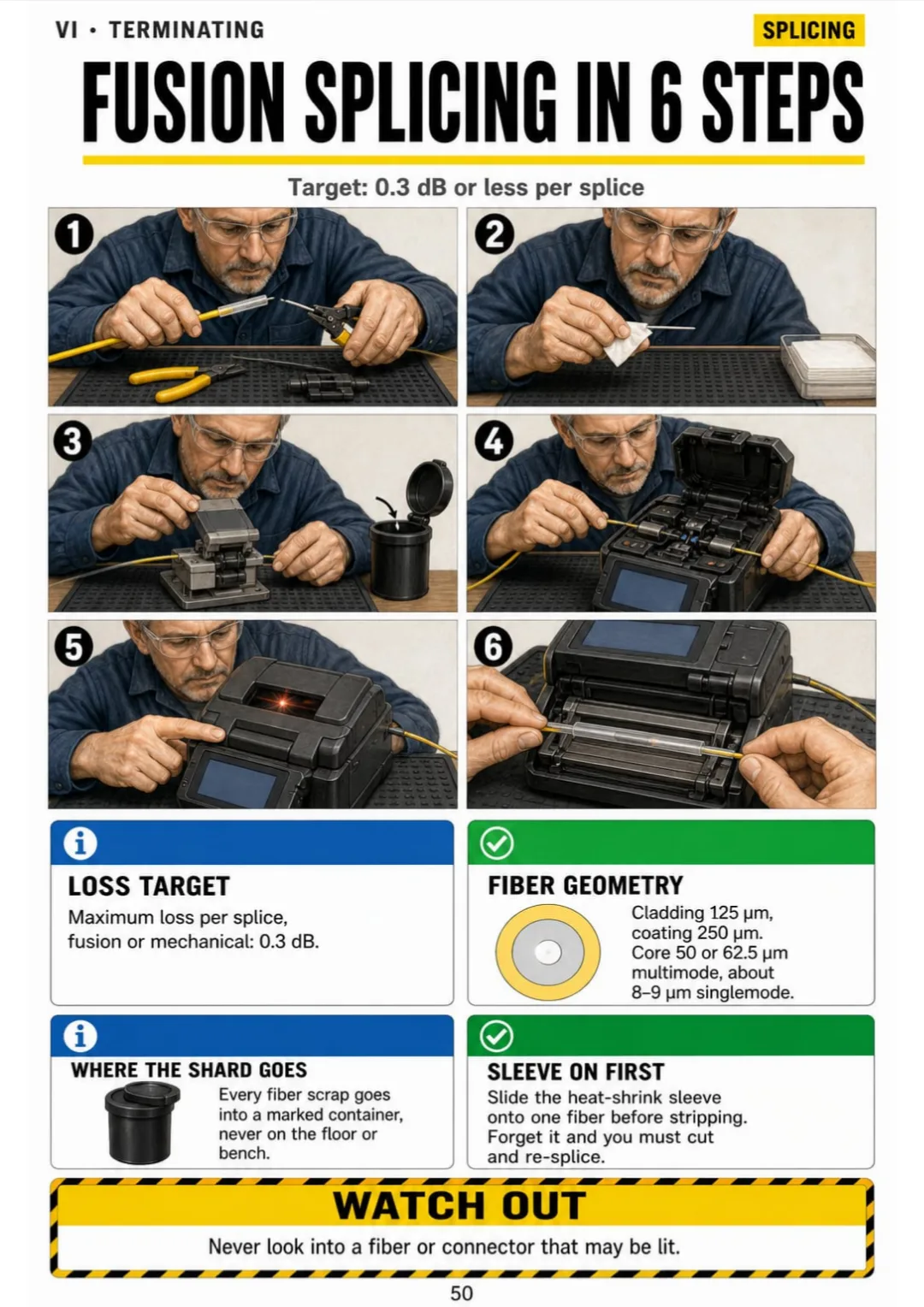
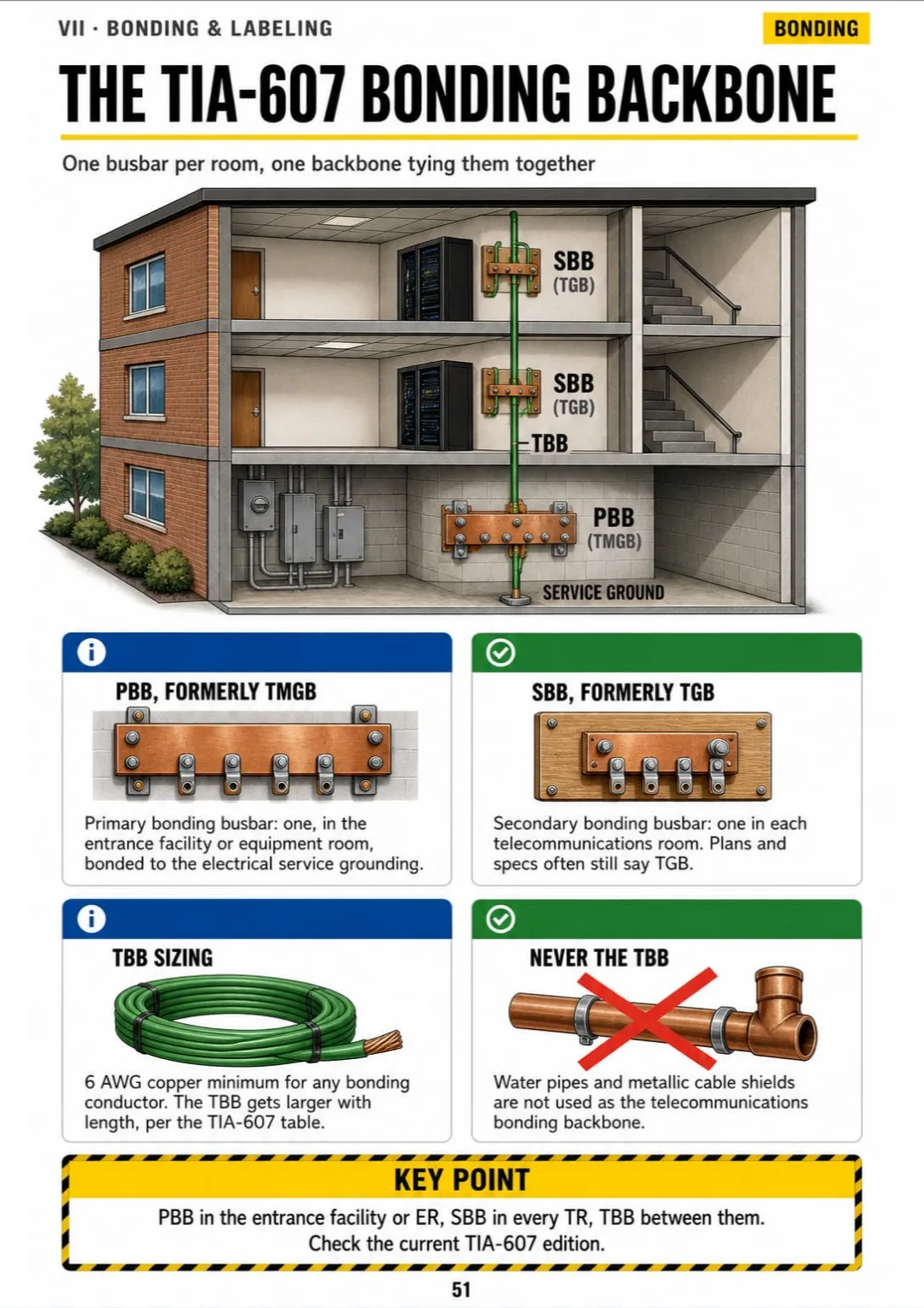
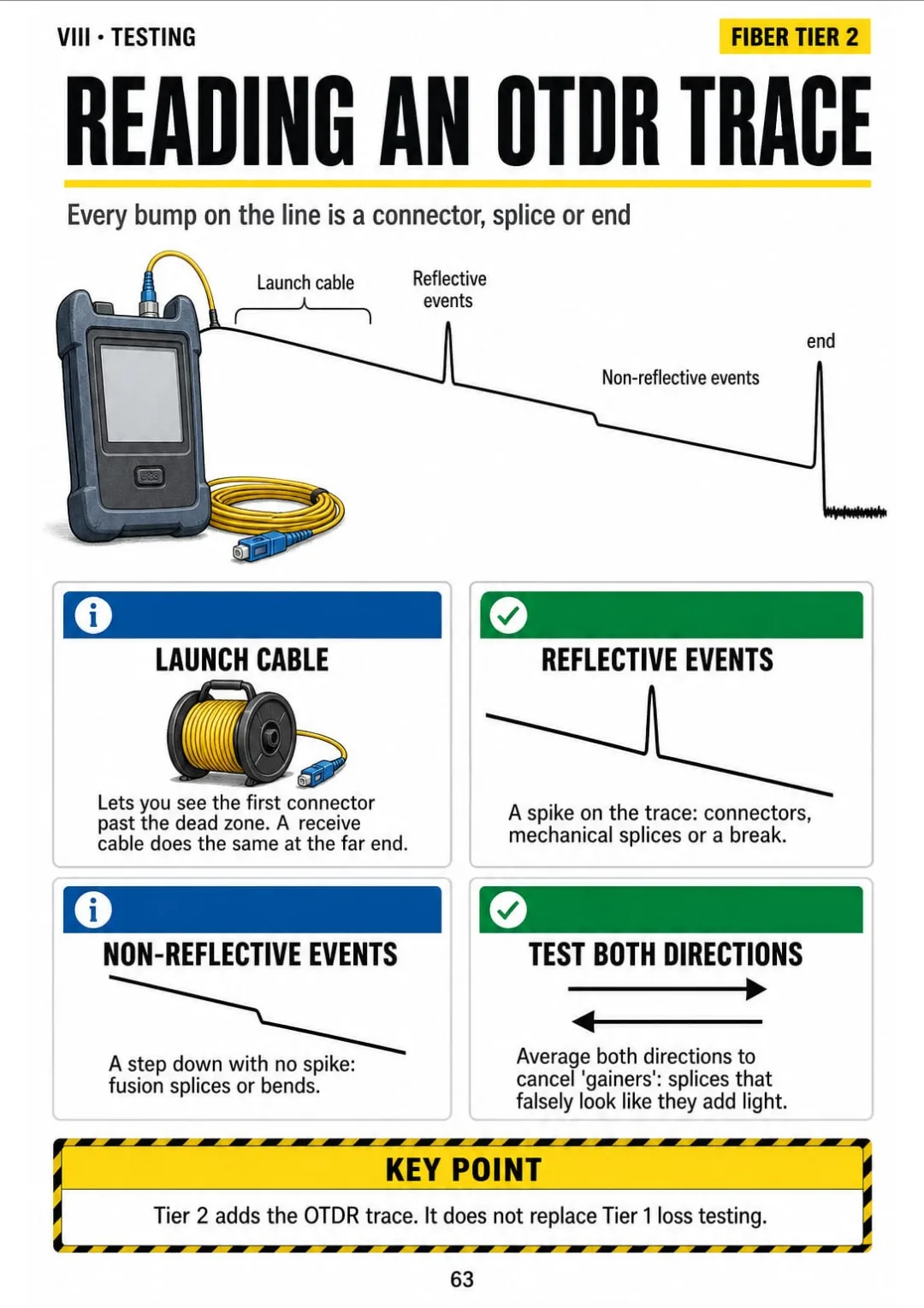
Same with T568A and T568B, the TIA-607 bonding backbone, fusion splicing and the OTDR trace: each one has its own page.
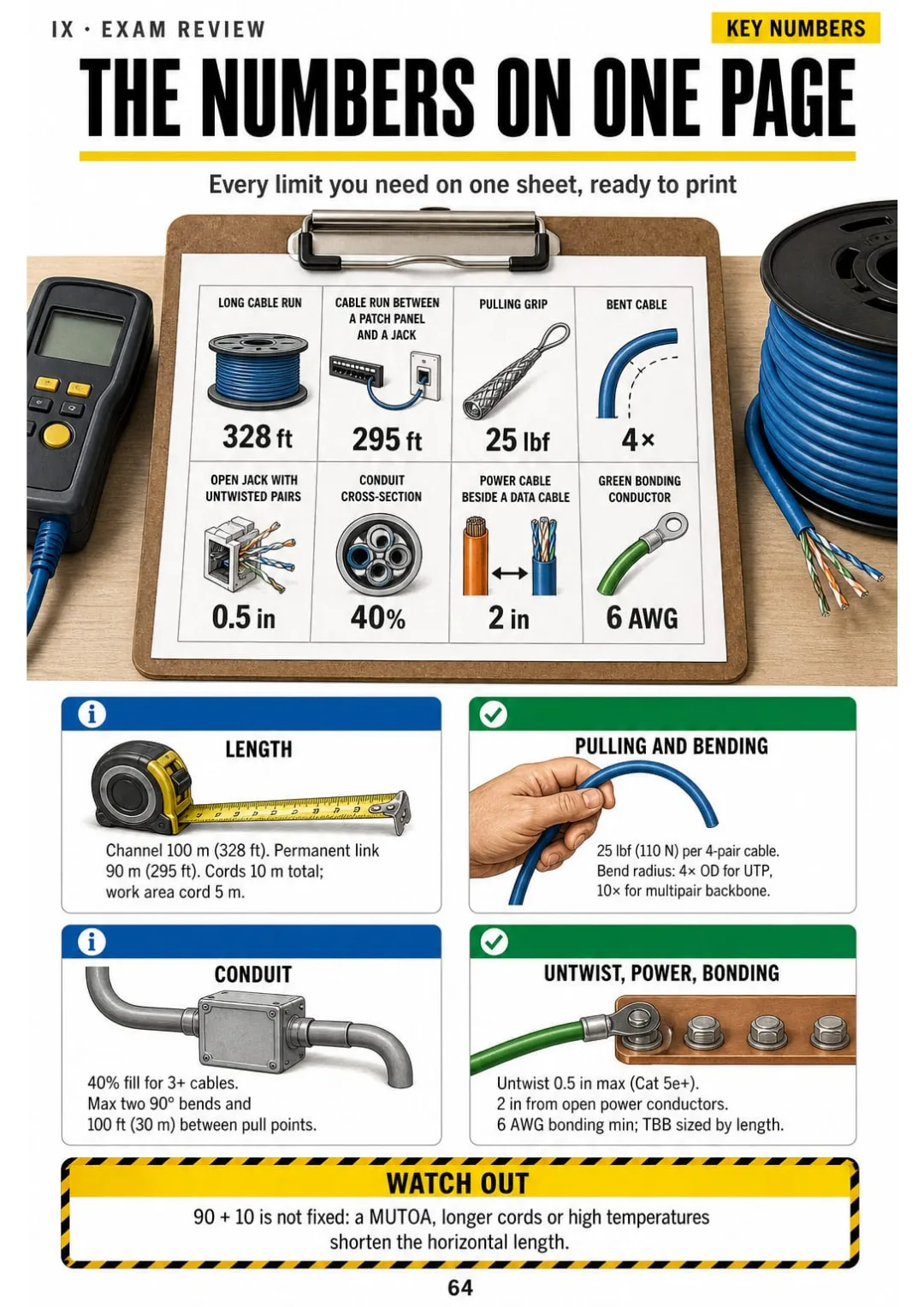
Cabling Installer Illustrated is 9 parts and 64 topics, all drawn, and it ends with all the key numbers on one page, the look-alikes that get mixed up and a hands-on test checklist.
What you see drawn, you don't have to memorize.
See the whole system as one path, so every topic has a place to land: the 6 subsystems in order, Distributors A, B and C, star topology, channel vs permanent link, work area, consolidation point and MUTOA
Inside a 4-pair UTP cable, Cat 5e vs Cat 6 vs Cat 6A, UTP, F/UTP and S/FTP, solid vs stranded, the 25-pair color code, CMP, CMR, CM, CMX and the fiber ratings
How light travels, multimode vs singlemode, OM1 to OM5 and OS1/OS2 by jacket color, tight-buffered vs loose-tube, the 12-fiber color code, LC, SC and ST, UPC vs APC and polarity
Entrance facility and demarc, equipment room and telecom room, rack layout, conduit fill, bends and pull boxes, J-hooks and cable tray, separation from power, walls and floors
The job walk, pulling copper in 5 steps, bend radius, pulling fiber, lubricant and pull aids, service loops and slack, cable ties, Velcro and crush
T568A and T568B pin by pin, pairs to pins, keystone jack in 6 steps, patch panel, the 110 block in 5 steps, RJ45 plugs, fiber connector methods and fusion splicing in 6 steps
The TIA-607 bonding backbone, bonding racks, trays and shields, firestopping a penetration, firestop do's and don'ts, the TIA-606 labeling scheme and as-built documentation
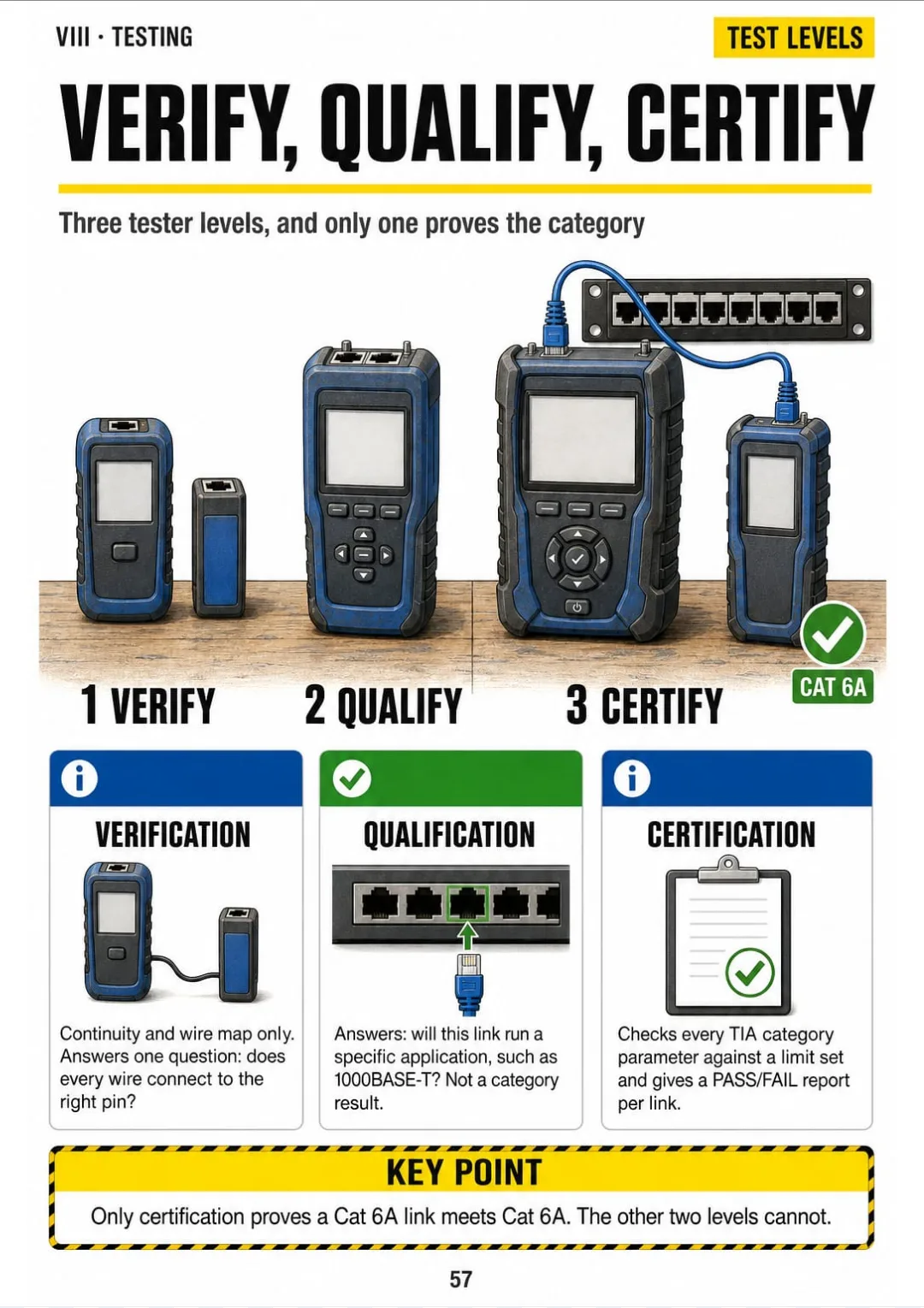
Read a tester report instead of just looking at PASS or FAIL: verification, qualification and certification, wire map faults, length, delay and skew, insertion loss and NEXT, return loss, PSNEXT and ACR-F, Tier 1 fiber testing and the OTDR trace
All the key numbers on one page, look-alikes that get mixed up, a hands-on test checklist, job-site safety and the most frequent installation errors
At the end of the book: A final review with all the key numbers on one page, the look-alikes that get mixed up and a hands-on test checklist.

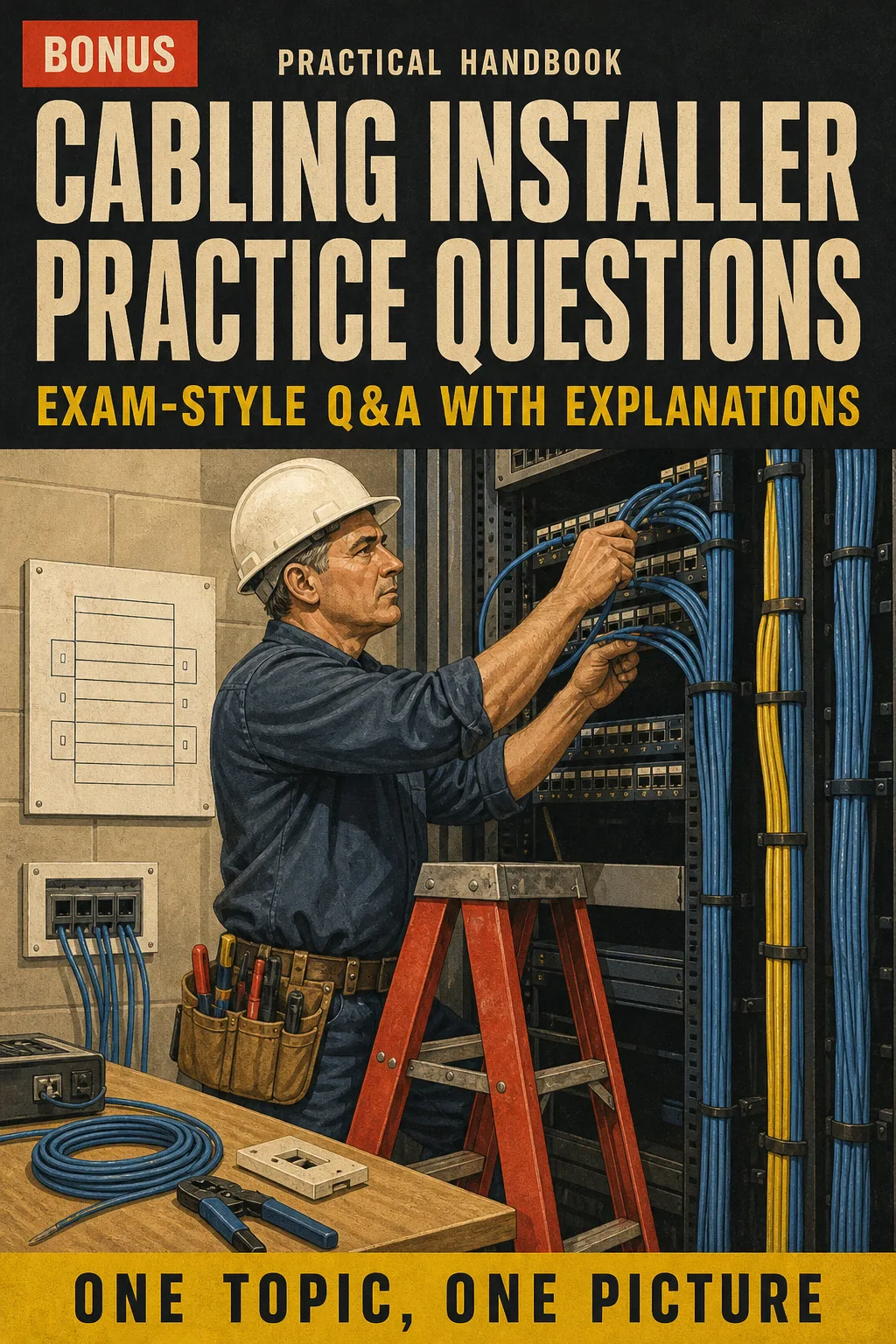
Test yourself on subsystems, cable ratings, fill, termination and testing, and see the page that explains every answer.

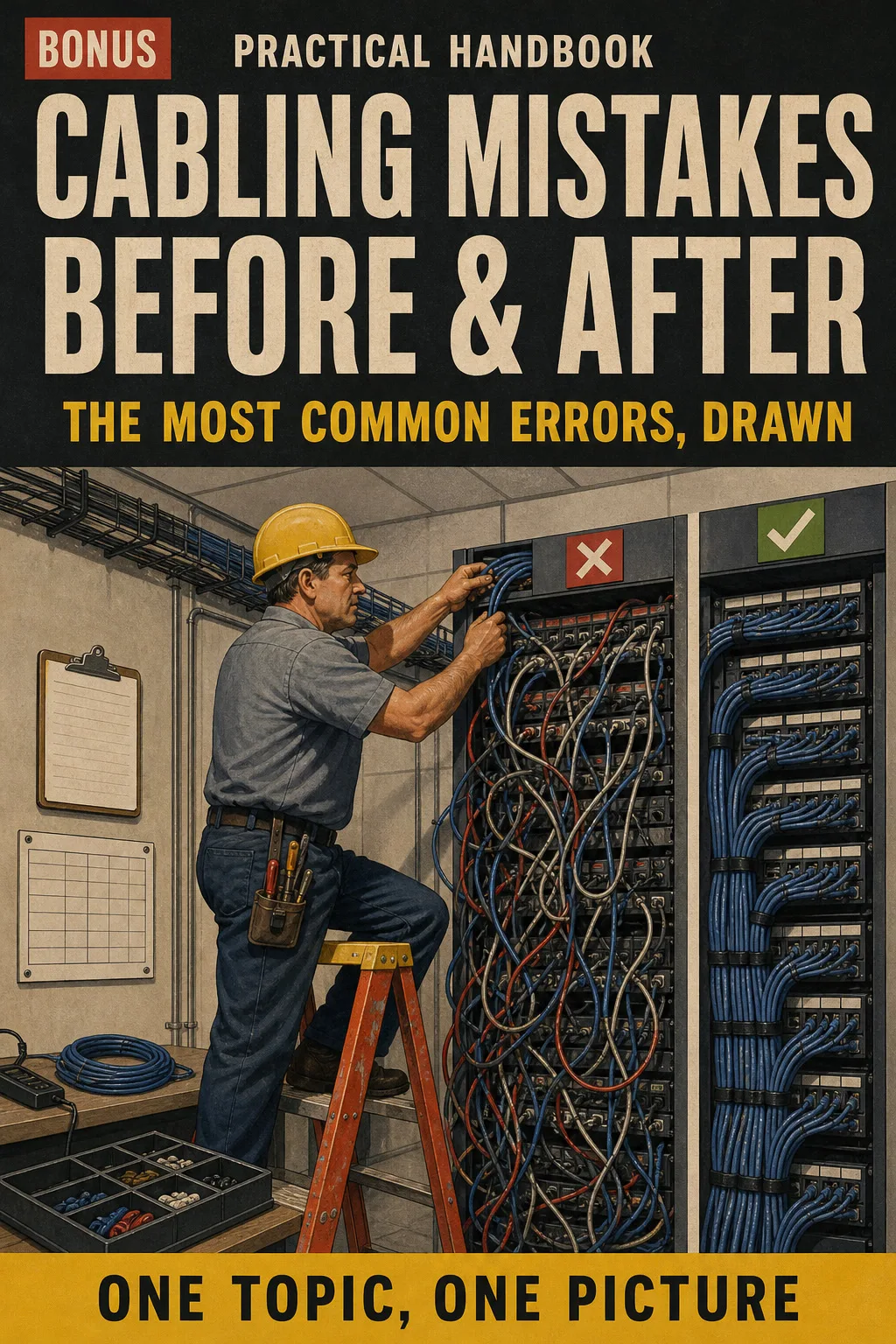
See the wrong way and the right way side by side, from too much untwist at the jack to a missing firestop, so you spot them on the job.
📄 This is a digital PDF book sent to your email: nothing is printed or shipped.
PDF by email: We email you Cabling Installer Illustrated as a PDF, together with the two free books. It's a single payment: no installments, no extra charges.
You get the whole system as one drawn path, from the entrance facility to the wall jack, so every topic in the manual has a place to land.
You review all the key numbers on one page, the look-alikes side by side and the hands-on checklist, then test yourself with the practice questions.
You keep it on hand for the job: pinouts, bend radius, fill, bonding and how to read a tester report, one page each, printed or on your phone.
📄 This is a digital PDF book sent to your email: nothing is printed or shipped.
Try Cabling Installer Illustrated for 30 days, bonus books included.
We refund everything if the file won't open, if the book isn't what you see here, if you were charged twice or if the email doesn't arrive. Just email us.
You pay once. No subscriptions.
Yes. It doesn't treat you as a beginner: it puts what you already do on one drawn map, with the standard behind each step and the numbers the BICSI manual and the TIA standards cover, like channel vs permanent link, fill, bend radius and test parameters. If you're newer, the first part gives you the whole system on one page.
It's checked against the current editions of ANSI/TIA-568, -569, -606 and -607 and the NEC (NFPA 70, Articles 770 and 800), and it follows the topic areas of the BICSI Installer 1 written and hands-on exams: safety, pathways and spaces, pulling, copper termination, basic fiber, bonding, labeling and testing. The fusion splicing and OTDR pages go one step further, for the job. Your state or city may enforce an older NEC edition, so check which one your AHJ has adopted. Standards text and tables aren't copied: everything is explained with our own drawings.
No. It's an independent illustrated study book, not affiliated with or endorsed by BICSI, TIA or NFPA. If you already have the official manual, this isn't the same text again: it's the same topics turned into one drawing per page, with the numbers you need in one box, so what takes several pages in the manual you review at a glance. Keep the manual as your reference and use this to review and to take to the job.
No. It's a study book: it doesn't give you a certificate, a credential or CEC credits. The INST1 credential only comes from passing BICSI's written and hands-on exams. The book helps you understand and review, but you still need your training course, hands-on practice and the requirements of your employer and local authority.
No. They're written for this book, in an exam-style format, and every answer points to the page that explains it. They're not official questions from any exam.
The book and the 2 bonus books come as a PDF by email, sent to the address you enter at checkout.
No. It's a one-time payment. No subscription, nothing recurring.
Yes. The PDF is ready to print, on a home printer or at a print shop, so you can keep it in the truck or take it to the job site.
You have 30 days. We refund everything if the file won't open, if the book isn't what you see on this page, if you were charged twice or if the email doesn't arrive: just email us.
No more rereading with nothing sticking.
T568A and T568B: you see them drawn and you're set.
You walk into the exam knowing where everything goes.
Drawings make studying faster.
The book is right below.
One-time payment: US$ 27 · Guarantee: 30 days · PDF by email
YES, I WANT CABLING INSTALLER ILLUSTRATED FOR US$ 27📄 This is a digital PDF book sent to your email: nothing is printed or shipped.